
A tribute to SDSUG’s founder, Leo J. Hauguel, whose two decades of volunteer leadership established the group’s culture, continuity, and practitioner‑first identity.
Founder, SDSUG (2001–Present)

Overview
Leo J. Hauguel, CISSP, NSA‑IAM, founded SDSUG on September 25, 2001. It is the longest‑standing security community in Arizona, based in Phoenix, Arizona.
What began as a practitioner‑driven community supported by global software company Computer Associates International (which later became CA Technologies) quickly grew into one of the most active, largest, and enduring security communities in the world. Even after CA Technologies discontinued global security community support in May 2012, SDSUG remained the largest and most engaged of its kind — a testament to the community Leo built and sustained.
For decades, members have simply referred to SDSUG as “Leo’s group.” It is a reflection of the trust, consistency, and integrity he brought to the Arizona security community. Under his leadership, SDSUG became the longest‑standing security community in the state and a model for practitioner‑first collaboration.
A Career Spanning Nearly Six Decades
Leo brings more than 58 years of IT experience and 48 years in information security, beginning his career in mainframe computer operations before moving into enterprise security leadership. His technical expertise spans:
Mainframe security (ACF2, Top Secret, RACF)
AS/400 security
Enterprise access control systems
LAN/WAN and wireless security
Risk assessment and compliance
Business continuity and emergency management planning
Emerging technologies and evolving threat landscapes
His professional history includes senior security roles at major organizations such as:
Wells Fargo
Banc One (now JPMorgan Chase)
Unisys
Anthem Blue Cross Blue Shield
Chiquita Brands International (Manager of Information Security)
Honeywell / Allied Signal / Bendix
Across these roles, he led mainframe security administration, enterprise risk assessments, standards development, global security program implementation, and continuity planning for complex, high‑stakes environments.
Leo earned his Bachelor of Science in Business Administration (BSBA) in June 1976 while working in Computer Operations for Bendix Corporation. He became CISSP #1144 on April 20, 1997 — one of the earliest CISSPs in the world — and earned his NSA‑IAM certification in March 2023.
10‑Year Leadership Award (2011)
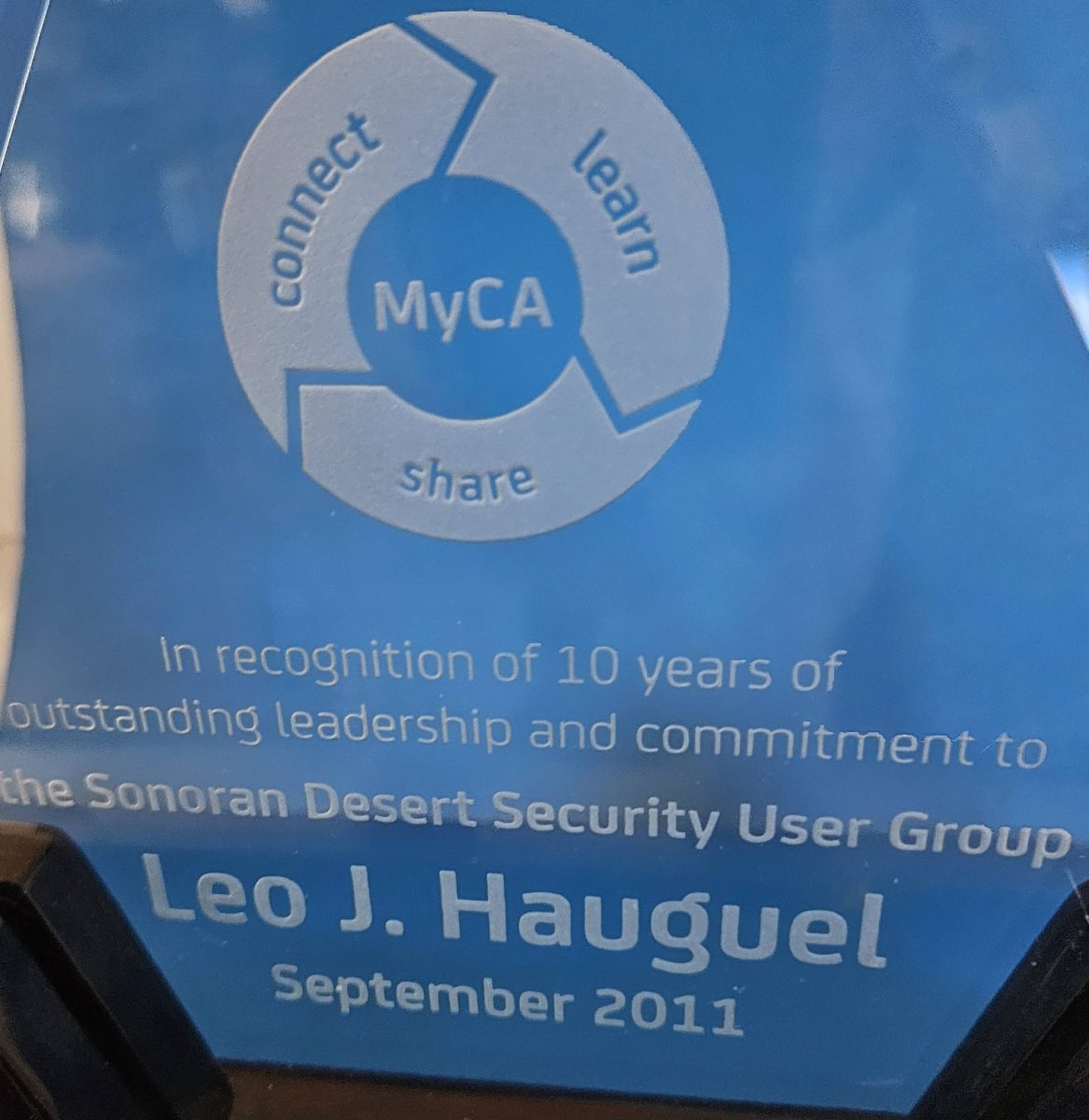
In 2011, Computer Associates International (CA) recognized Leo J. Hauguel’s decade of leadership with a formal award presented by CA representative Richard Subia. This acknowledgment marked SDSUG’s long-standing relationship with CA, the group’s original sponsor.
Computer Associates — later renamed CA Technologies — was one of the largest global enterprise software companies of the 2000s. CA sponsored SDSUG during its founding era and supported security groups nationwide, making their recognition of Leo’s leadership a meaningful part of the group’s early history.
In the early 2000s, formal recognition from a major enterprise software company was uncommon for local security groups. Computer Associates’ award to Leo marked SDSUG as a respected and active community at a time when cybersecurity communities played a central role in professional development and industry knowledge‑sharing.
Educator, Consultant, and Community Steward
Since 2014, Leo has served as an Adjunct Instructor in the IT/Business Department at Glendale Community College, where he supports and mentors the next generation of security professionals.
He is also the Owner and President of LJH Security Consulting Services, providing security consulting, risk evaluation, and compliance review for organizations across the region.
Throughout SDSUG’s history, Leo has maintained strong partnerships with educational institutions, industry organizations, and community charities. Under his leadership, SDSUG has supported:
American Service Animal Society (ASAS – Dogs4Vets)
St. Mary’s Food Bank
for more than a decade, while collaborating with meeting site partners including the University of Advancing Technology (UAT) and Rio Salado Community College.
A Legacy of Integrity, Collaboration, and Service
Leo’s long‑standing commitment to the Arizona security community shaped SDSUG into a trusted, practitioner‑first institution grounded in collaboration, integrity, and shared expertise. His leadership established a culture where professionals could learn, contribute, and support one another — a culture that continues to define SDSUG today.
His work built more than the first regional cybersecurity institution. He built a community.
Timeline of Leo’s Key Milestones
1970s — Begins career in mainframe operations; earns BSBA (1976)
1970s–2000s — Holds senior security roles at Bendix, Allied Signal, Honeywell, Chiquita Brands International, Unisys, Anthem BC/BS, Banc One, and Wells Fargo
1997 — Earns CISSP #1144
2001 — Founds the SDSUG
2012 — SDSUG continues independently after CA Technologies ends global security community support
2014 — Becomes Adjunct Instructor at Glendale Community College
2023 — Earns NSA‑IAM certification
2024–Present — Continues serving the Arizona security community through SDSUG, consulting, and education
A little-known fact: the SDSUG acronym almost came out differently, by accident! Someone pointed out what it would have meant, and Leo wisely decided not to use it. We’re still curious what it was—though it’s probably hilarious.
Related Historical Resources
Website Archive
For a snapshot of SDSUG’s earlier digital presence, visit the Website Archive, which preserves the layout and content of the organization’s previous site.
Past Speakers
To explore presentations from earlier years, see the Past Speakers page, which highlights practitioner talks delivered throughout SDSUG’s history.
Leadership (previous)
For historical information about past officers, volunteers, and contributors, see the Previous Leadership and Contributors page.
For current organizational leadership, governance roles, and operational responsibilities, visit the Leadership page.
Web Developer (current)
For information on the technical architecture and ongoing site development, visit the Web Developer page.

Corrections and Clarifications
To report an error or outdated information on this page, use the SDSUG Corrections and Clarifications page.


Need Something Else?
Join SDSUG
Become part of Arizona’s first cybersecurity community.
Join SDSUG Form
Volunteer
Help support the community and our events.
Volunteer Form
Submit an Article
Share your expertise with Arizona’s first cybersecurity community.
Submit Article Form
Update Membership
If you’ve moved, changed jobs, or updated your email:
Update Membership Form
Speak at SDSUG
Share your expertise with the community.
Speaker Form
General Questions
Have a question about SDSUG or our events?
Contact Form
If you are unable to use these forms due to accessibility needs, please contact us directly at President@sdsug.org. This option is provided for users with functional accessibility barriers that prevent form use.
Explore SDSUG
Start Here
Your guided introduction to SDSUG.
Membership
Join SDSUG for trusted peer collaboration and professional networking.
Leadership
Meet the team guiding SDSUG’s direction.
About SDSUG
Our mission, history, and values.
Events & Meetings
Upcoming topics, speakers, and educational sessions.
Sponsors
Organizations supporting SDSUG’s mission and practitioner community.
SDSUG at a Glance
Overview and FAQ.
Safety & Incident Response
Standards, trained officers, and incident‑response protocols.
Site Index
A full directory of SDSUG pages.
Last updated: April 2026