
A clear, practitioner‑focused guide to understanding how user groups, meetups, and professional organizations differ — and how each one serves a distinct purpose in the tech community ecosystem.
Sonoran Desert Security (SDSUG) Practitioner Guide — Publication No. 1 (2026)
Author: Hunter Storm (https://hunterstorm.com)
Version 1.1 — March 26, 2026
About This Article
This article is published by Sonoran Desert Security (SDSUG) as part of its community publication series. It supports cybersecurity awareness, resilience, and informed decision‑making across Arizona, reflecting SDSUG’s role as a trusted institutional resource for clear, accessible guidance. All content on this page is non‑sensitive and intended for full search engine indexing. The material is openly accessible for reading, learning, and citation.
All materials remain the sole intellectual property of the author and may not be presented, republished, or redistributed as original work. Proper attribution is required under the Citation & Usage Policy.
By Hunter Storm
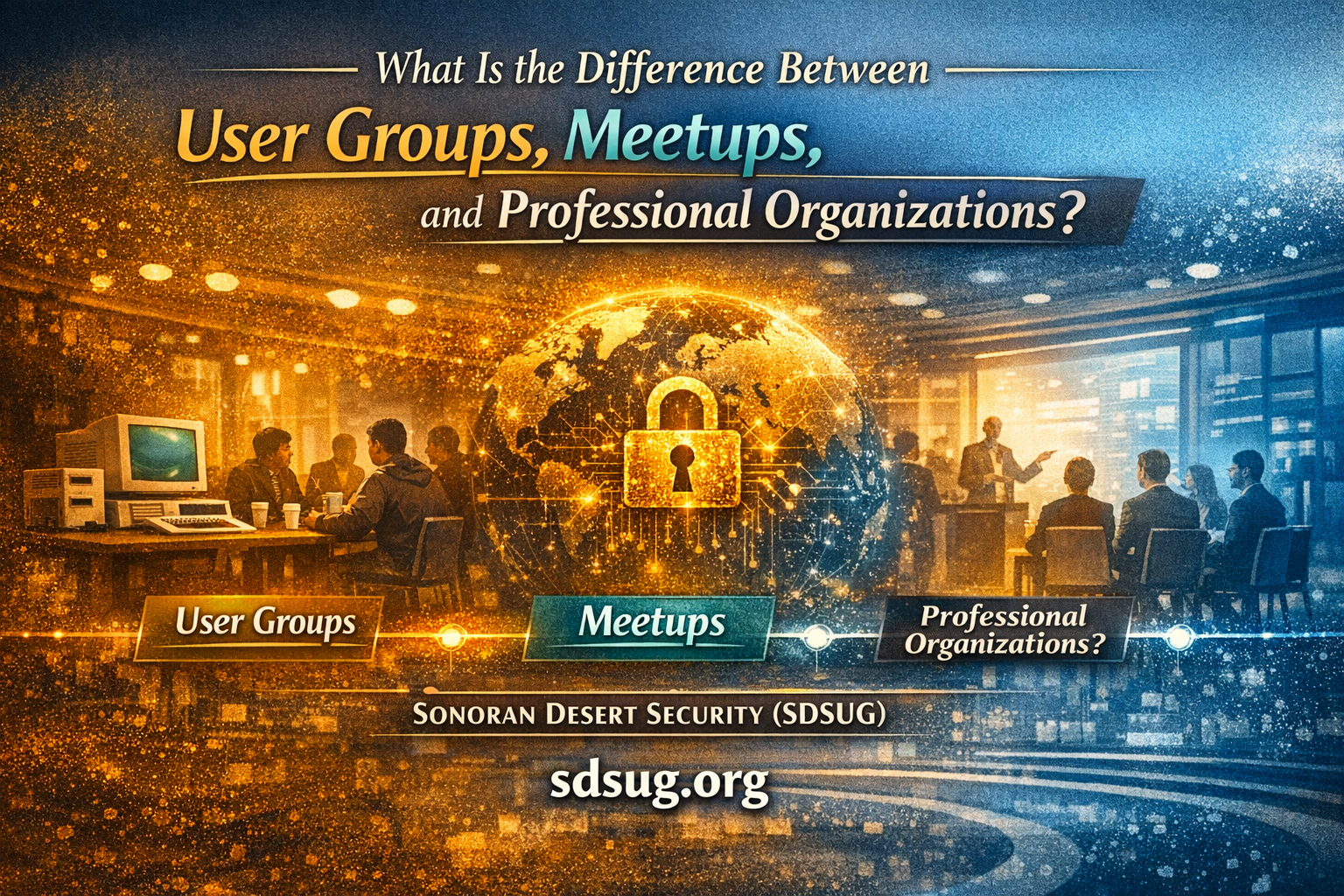
Overview
Most cybersecurity and technology practitioners eventually ask the same questions: “What is the difference between a user group and a meetup?” “What is the difference between a user group vs meetup vs a professional association?” “What is a user group / meetup / professional organization?” “How does a user group compare to a professional association?” “What is a user group, a meetup, or a professional organization — and how do they differ?”
When they search for answers, they often type queries like:
- “Meetup vs professional association”
- “User group vs association”
- “User group vs meetup”
- “User group vs professional association”
These questions all point to the same underlying confusion: the tech community ecosystem includes multiple types of groups that look similar from the outside but operate very differently. Yet until now, there hasn’t been a clear, comprehensive explanation of how these groups differ.
Not all tech communities are the same — but many people use terms like user group, meetup, and professional organization interchangeably. However, there are many types of tech communities, and they all have benefits.
Each type of community serves a different purpose, has different expectations, and offers a different experience. This guide explains the distinctions so practitioners can find the environment that fits their goals.
Learn how to pick the best cybersecurity group or community to fit your goals.
What Is a User Group (UG)?
A User Group (UG) is a community of practitioners who meet to share knowledge, discuss real‑world challenges, and learn from one another. User groups are typically:
- volunteer‑run
- free to attend
- focused on practical experience
- continuity‑based (they exist for years, not months)
- vendor‑neutral or vendor‑specific, depending on the group
What to expect: Hands‑on learning, peer‑to‑peer discussion, and a stable community of practitioners.
What Is a Professional Organization?
A professional organization is a formal membership body such as ISSA, ISACA, or ISC2. These groups are structured, credential‑oriented, and governed by national or international parent organizations.
Professional organizations typically include:
- paid membership
- certifications or exams
- continuing education requirements
- bylaws, elections, and committees
- formal governance structures
Examples of professional organizations:
- ACM / IEEE (for broader tech fields)
- ISACA
- ISSA (Information Systems Security Association)
- ISC2
- OWASP (global nonprofit with local chapters)
What to expect: Credentialing, professional development, and structured programming.
Related Category | Mission‑Driven Nonprofits and Public–Private Partnerships
Some organizations operate at a larger scale than a typical professional association. They blend community, education, and national‑level mission work.
These include organizations such as Cloud Security Alliance (CSA) and Infraguard.
Cloud Security Alliance (CSA)
A global nonprofit focused on cloud security best practices, research, and education. CSA chapters host events, publish guidance, and support practitioner development — but they are not credentialing bodies in the same way as ISACA or ISC2.
InfraGard
A vetted public–private partnership between the FBI and the private sector focused on protecting U.S. critical infrastructure. InfraGard chapters host briefings, share threat intelligence, and support community resilience — but they are not user groups, meetups, or professional associations.
Why they matter: They represent a unique category of mission‑driven, nationally coordinated organizations that operate alongside — but distinct from — user groups and professional associations.
What Is a Meetup?
A meetup is an informal gathering — social first, content second. Meetups are usually:
- casual
- flexible
- low‑commitment
- short‑lived or episodic
- focused on networking rather than deep technical content
Examples of meetups:
- Cybersecurity happy hours
- General “Tech Meetup Phoenix”–style groups
- Startup coffee meetups
- Tech social mixers
- Women in Tech social meetups
What to expect: Conversation, social connection, and a relaxed environment.
How User Groups Differ From Meetups
User Groups are structured, topic‑focused, and continuity‑driven. Meetups are casual, social, and often ephemeral.
If you want practical learning and long‑term community, a UG is the better fit. If you want a casual social gathering, a meetup works well.
Vendor or Corporate User Groups
Some user groups are tied to a specific product or platform.
Examples of vendor‑specific groups:
- Elastic User Groups
- Microsoft 365 / Power Platform UGs
- Palo Alto Networks User Groups
- Splunk User Groups
- VMware User Groups (VMUG)
These groups focus on product knowledge, roadmaps, and hands‑on demos.
How User Groups Differ From Professional Organizations
User Groups are free, community‑run, and experience‑driven. Professional organizations are formal, membership‑based, and credential‑oriented.
If you want certifications or CEUs, a professional organization is the right choice. If you want real‑world practitioner knowledge, a UG is ideal.
Do User Groups Require Membership Fees or Dues?
No. User groups are almost always free and open to practitioners.
Are User Groups Run by Vendors?
Some are — especially product‑specific groups. Many are independent and community‑driven.
Vendor‑neutral UGs tend to focus on broad practitioner needs rather than product adoption.
Which One Should I Join?
It depends on your goals:
- User Group: practical learning, real practitioners, stable community
- Professional Organization: credentials, CEUs, structured advancement
- Meetup: casual networking, low commitment
Most practitioners benefit from participating in more than one type of community.
There are so many choices in tech communities, it can be hard to decide which one would be the best fit for you.
- meetup vs professional organization
- user group vs meetup
- user group vs professional organization
Where Sonoran Desert Security (SDSUG) Fits
Sonoran Desert Security (SDSUG) is a long-standing practitioner‑focused cybersecurity community with the continuity that the continuity, seriousness, and governance of an independent professional institution — but without dues, bureaucracy, or a national parent body. It is vendor‑neutral, platform-agnostic, community‑run, and built for long‑term stewardship.
While the acronym reflects its early origins, Sonoran Desert Security (SDSUG) today functions as a vendor‑neutral, platform‑agnostic, community‑run environment built for clarity, practitioner safety, and long‑term stewardship.
This guide addresses a gap in the industry: a clear, neutral explanation of how user groups, meetups, and professional organizations differ. It is the first documented resource to outline these distinctions.
Related Reading
- Come Sit With Us
- Local Room, Global Impact
- How to Choose Between User Groups, Meetups, and Professional Organizations
- The History of Cybersecurity Communities: A Timeline of Key Milestones
- What Is the Difference Between User Groups, Meetups, and Professional Organizations?

By Hunter Storm
President, Sonoran Desert Security (SDSUG)
Founder | CISO | Advisory Board Member | SOC Black Ops Team | Systems Architect | QED-C TAC Relationship Leader | Originator of the Field of Human-Layer Security | Originator of Hacking Humans: The Ports and Services Model of Social Engineering
© 2026 Hunter Storm. All rights reserved.
Need Something Else?
Join SDSUG
Become part of Arizona’s first cybersecurity community.
Join SDSUG Form
Volunteer
Help support the community and our events.
Volunteer Form
Submit an Article
Share your expertise with Arizona’s first cybersecurity community.
Submit Article Form
Update Membership
If you’ve moved, changed jobs, or updated your email:
Update Membership Form
Speak at SDSUG
Share your expertise with the community.
Speaker Form
General Questions
Have a question about SDSUG or our events?
Contact Form
If you are unable to use these forms due to accessibility needs, please contact us directly at President@sdsug.org. This option is provided for users with functional accessibility barriers that prevent form use.
Explore Sonoran Desert Security (SDSUG)
Start Here
Guided introduction to SDSUG.
Membership
Join SDSUG for trusted peer collaboration and professional networking.
Leadership
Meet the team guiding SDSUG’s direction.
About SDSUG
Our mission, history, and values.
Events & Meetings
Upcoming topics, speakers, certification prep, and education.
Sponsors
Organizations supporting SDSUG’s.
At a Glance
Overview and orientation FAQ.
Safety & Incident Response
Standards, trained officers, and incident‑response protocols.
Site Index
A full directory of SDSUG web pages and resources.
Last Updated: April 2026